We've all been there. You gather the team, fire up the whiteboard, brainstorm for an hour, and leave with 47 sticky notes, a vague sense of progress, and absolutely no idea what happens next. Two weeks later, the board is still sitting there untouched.
The problem isn't whiteboards. They're one of the best tools for visual thinking, alignment, and creative problem-solving. The problem is how most teams use them — as open-ended idea dumps with no structure, no follow-through, and no connection to actual outcomes.
After working with thousands of teams on Overboard, we've noticed a clear pattern: the teams that get real results from their whiteboard sessions do five things differently. Here they are.
This sounds obvious, but most teams skip it. They open a blank board, say "let's brainstorm about the Q3 launch," and start posting sticky notes. An hour later, they have ideas scattered everywhere and no clarity on what they were actually trying to decide.
The fix: Before anyone touches the board, write one sentence at the top: "By the end of this session, we will have ___." Fill in the blank. It could be "a prioritized list of 3 features for the next sprint," or "a decision on which market to enter first," or "a go/no-go on the partnership deal."
That one sentence changes everything. It gives the session a destination. It stops the conversation from spiraling into tangents. And when you're done, you can look at the board and say definitively whether the session was a success.
Put the outcome statement in a fixed frame at the top of your board. In Overboard, you can pin it so it stays visible even as the canvas grows. It's a constant reminder of why you're all there.
Open-ended brainstorming feels productive because people are talking and ideas are flowing. But research consistently shows that constrained sessions produce better outcomes than unlimited ones. Parkinson's Law applies to whiteboards too: work expands to fill the time available.
The best teams split their sessions into tight blocks:
5 minutes — silent individual brainstorming (everyone writes their own sticky notes without discussion). This prevents groupthink and gives introverts equal airtime.
10 minutes — group sharing and clustering. Everyone places their notes and the group organizes them into themes.
10 minutes — voting and prioritization. Dot-voting or stack-ranking to surface the top ideas.
5 minutes — assign owners and next steps.
That's 30 minutes for a complete brainstorm-to-action cycle. Compare that to the typical 90-minute session that produces the same number of actionable outcomes (often zero).
The best whiteboard sessions feel short. If your team walks out saying "that was quick and we got a lot done," you nailed it.
A blank whiteboard is intimidating. It's the visual equivalent of a blank page — full of potential but paralyzing in practice. Most teams default to the same tired approach: random sticky notes on an infinite canvas.
Structured templates change the game. Instead of "let's brainstorm," you start with a framework that guides the thinking. A few that work particularly well:
The 2x2 Matrix — plot ideas on two axes (e.g., effort vs impact) to immediately see what's worth doing. This kills the "everything is equally important" trap.
The Start/Stop/Continue — for retrospectives. Three columns that force specificity instead of vague sentiments.
The Affinity Map — brainstorm freely, then cluster related ideas into themes. The structure emerges from the ideas, not the other way around.
The Decision Matrix — score options against weighted criteria. Turns subjective debates into something closer to objectivity.
The key is that the template does the thinking about how to brainstorm so your team can focus on what to brainstorm about.
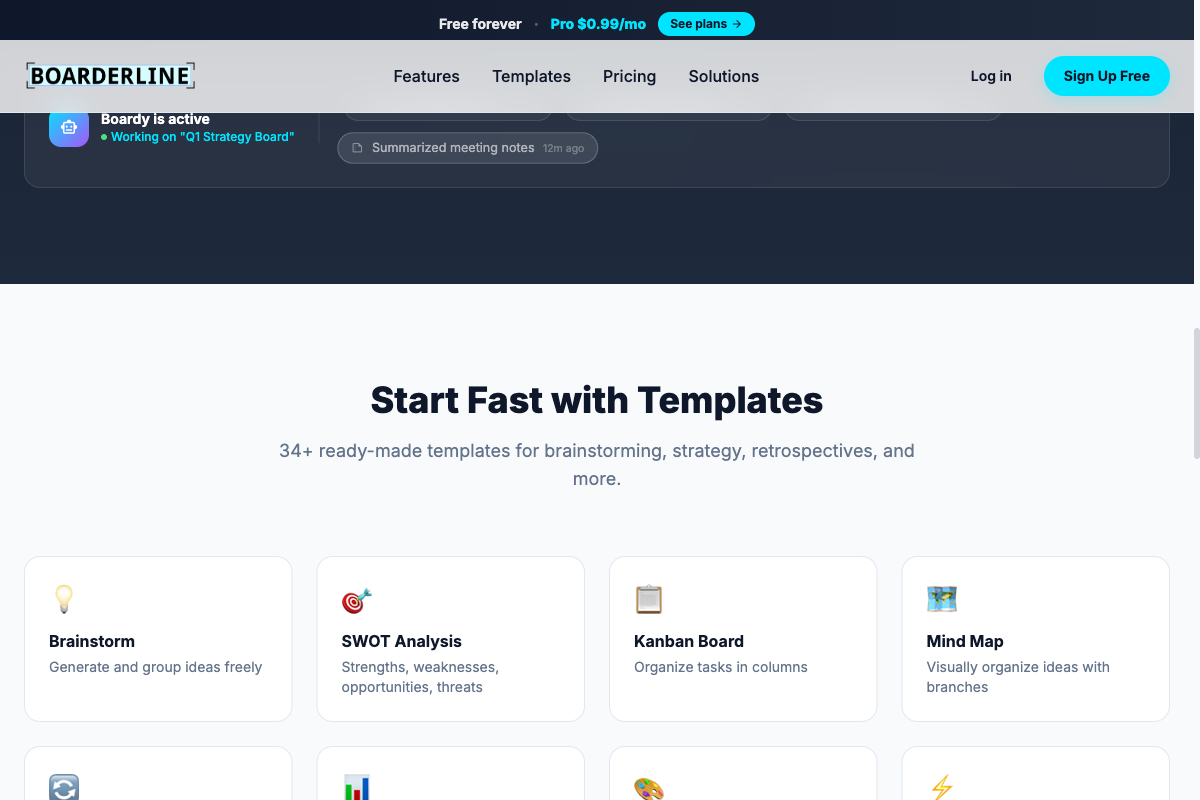
Overboard's template library includes all of these frameworks, pre-built and ready to go. Pick one before the session starts and share the board link with your team. They'll show up knowing exactly what they're walking into.
Try a structured whiteboard session
Overboard's templates are designed to drive outcomes, not just capture ideas. Free for teams up to 5.
Try Overboard FreeThis is where 90% of whiteboard sessions fall apart. The brainstorm goes great. Ideas are flowing. Everyone feels energized. And then... the meeting ends. No one captures the key decisions. No one assigns follow-ups. The board becomes a museum exhibit — interesting to look at, but disconnected from actual work.
The traditional fix is to assign someone to take notes and extract action items. But that person is now half-participating, half-documenting. And the notes they write often miss the nuance of the conversation.
The better fix: let an AI teammate do it.
This isn't science fiction — it's happening right now. In Overboard, there's an AI agent called Vorlika that joins your whiteboard sessions as an active collaborator. Not a passive tool you invoke. An actual participant that watches the session unfold and takes action.

Here's what that looks like in practice: your team is brainstorming. Sticky notes are flying. Vorlika is silently clustering ideas into themes, identifying patterns you might miss, and noting points of disagreement. When the brainstorm wraps, Vorlika has already generated a summary with every action item, every key decision, and every open question — organized and ready to go.
But it goes further than note-taking. Vorlika actively leads the project forward:
During sessions: Generates ideas, challenges assumptions, and expands your team's thinking. It's like having a fresh perspective that never gets tired or distracted.
After sessions: Extracts action items with owners and deadlines. Creates task lists. Generates project timelines from the brainstorm content.
Between sessions: Surfaces what's stuck, reminds the team about uncommitted decisions, and suggests next steps based on what's changed on the board.

The best project manager doesn't need to be a person. The best one is the one who never forgets a follow-up, never gets distracted, and never drops the ball between meetings.
The shift here is subtle but powerful. Instead of the whiteboard being a passive surface where humans do all the work, the whiteboard becomes an active participant in getting the project done. The AI doesn't replace your team's creativity — it replaces the grunt work that kills momentum between sessions.
The whiteboard graveyard is real. Every team has them: dozens of boards from past brainstorms, retros, and workshops that nobody has opened since the day they were created. This is the biggest waste of whiteboard potential — all that thinking, all those ideas, slowly becoming irrelevant.
Winning teams treat boards as living documents. They revisit them. They update status on action items. They move ideas forward or explicitly archive them. The board isn't a snapshot of one meeting — it's a project tracker that started with a brainstorm.
A few practical habits that help:
Weekly check-ins. Spend 5 minutes at your weekly standup reviewing the board. What's done? What's stuck? What needs to change?
Status colors. Use green/yellow/red to mark the state of each action item directly on the board.
Archive intentionally. When a project is done, archive the board with a summary of what was decided and what shipped. Future you will thank present you.
In Overboard, you can track progress directly on the canvas — mark items as done, in-progress, or blocked without leaving the board. The board becomes the project tracker, not just the brainstorm surface.
The common thread across all five tricks? They move whiteboards from being passive idea collectors to active project drivers. The difference between a team that brainstorms well and a team that ships well is almost entirely in how they handle the gap between "we had a great session" and "we actually did the thing."
You don't need a new process. You don't need a new meeting cadence. You just need to be more intentional about five things: set an outcome, timebox it, use structure, let AI lead the follow-through, and revisit the board.
The ideas are already there. The hard part is turning them into outcomes. That's what winning whiteboard sessions do.